
Written by Katarina B Koten.
Mornings in Tuawolo Village, East Adonara District, East Flores Regency, East Nusa Tenggara, always begin with the sound of roosters crowing and the clanging of pots from Mama Petronela Sura Pati’s kitchen.
Tuawolo Village is located west of Mount Boleng, a volcano that is the pride of Adonara residents. Its hillside location makes the air in the village cool and fresh, especially in the mornings when fog sometimes still descends, blanketing the roofs of residents’ homes.
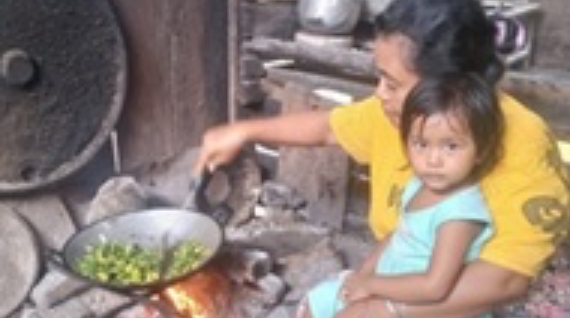
Amidst this coolness, Mama Petronela, or Mama Nela as she is affectionately known, has been busy since before sunrise. Her right hand stirs a spoon in a pan, while her left arm cradles her youngest child, who cries for attention.
Four children born close in age kept her days constantly busy. As one child was just learning to walk, another was already born. “I used to think it was normal. Children are a blessing from God,” she said with a faint smile, recalling those difficult times.
Since childhood, this woman, born on July 2, 1975, grew up believing that participating in the Family Planning (KB) program meant rejecting God’s blessing. “I was afraid to use birth control pills because they said it could cause infertility,” she whispered. She acquired this view from stories told by people in the village. No one explained what family planning truly meant.
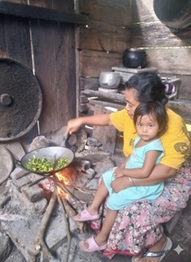
At night, the children’s cries often broke the silence, vying for their mother’s embrace. “Sometimes I would cry silently. It felt like my life was just cooking, washing, and comforting the children,” she recalled softly, stroking the hair of her youngest in her lap.
A turning point in her life came unexpectedly. One day, at the Tuawolo Village Hall, a Non-Governmental Organization from Larantuka called the Foundation for Social Studies and Development (YPPS) held a socialization program for women’s health named TAKENUSA, or Joint Determination for Women’s Health in Nusa Tenggara.
Initially, Mama Nela came only because she was invited by a relative. She sat in the back row and listened carefully to the explanation about reproductive health, family planning (KB), and Post-Abortion Care. When the speaker explained that family planning was not about rejecting children, but rather about spacing pregnancies to ensure the mother’s health and the child’s proper development, Mama Nela was stunned.
“All this time, I misunderstood,” she whispered. From that moment, Mama Nela decided to learn more. She attended counseling sessions and began using a family planning method suitable for her condition.
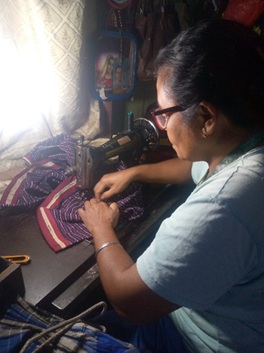
This change in perspective brought a breath of fresh air into her life. Her body was now fitter, her mind calmer. With her mother’s old sewing machine, she began sewing clothes at home. Initially, she only mended neighbors’ clothes, but gradually, many people came bringing fabric to be made into garments. Her sewing now became an additional source of income for her family.
At every meeting with her sewing customers, social gatherings, PKK activities, and even village events, Mama Nela always captured attention. She shared her story with simple and easily understandable words. “If we participate in the family planning program, our bodies can rest, children grow up healthy, and mothers remain strong,” she said with a warm smile.
Slowly but surely, the message began to resonate in the hearts of the mothers in her village. From casual chats under trees to formal discussions at the village hall, Mama Nela’s gentle voice became a bridge of knowledge about the importance of maintaining maternal and child health through the family planning program.
Now, in Tuawolo Village, a small, cool village on the slopes of Mount Boleng, Mama Nela is known as an agent of change. The woman who once feared and misunderstood family planning has now become a source of information for many. She has not only transformed her own life but also given hope to other women to bravely take control of their bodies and their future.
“The knowledge I possess is not enough for myself,” she said with eyes full of conviction, “but I also want all families, especially other mothers, to be brave enough to make the right decisions for their families’ future.” She added.
Mama Nela believes that many people in East Flores, especially on Adonara Island, still do not fully understand the Family Planning Program. Moreover, there are challenges from patriarchal culture and the obligation to have male children in a marriage. Beyond that, she hopes that the government and health workers will not stop providing understanding, just as YPPS has done.
“I am certain that many people in East Flores, especially on Adonara Island, still do not truly understand the family planning program,” Mama Nela stated gently yet firmly. “Especially with our custom that every marriage must have a male child.” She then added, “But I hope that the government and health workers will not stop providing understanding to the community, as this foundation has already done.”
For her, change began with the small realization that being a mother does not mean losing oneself. From exhaustion, she found strength. From misunderstanding, she found knowledge. And from there, the spirit grew to change not only her own life but also that of her village.