
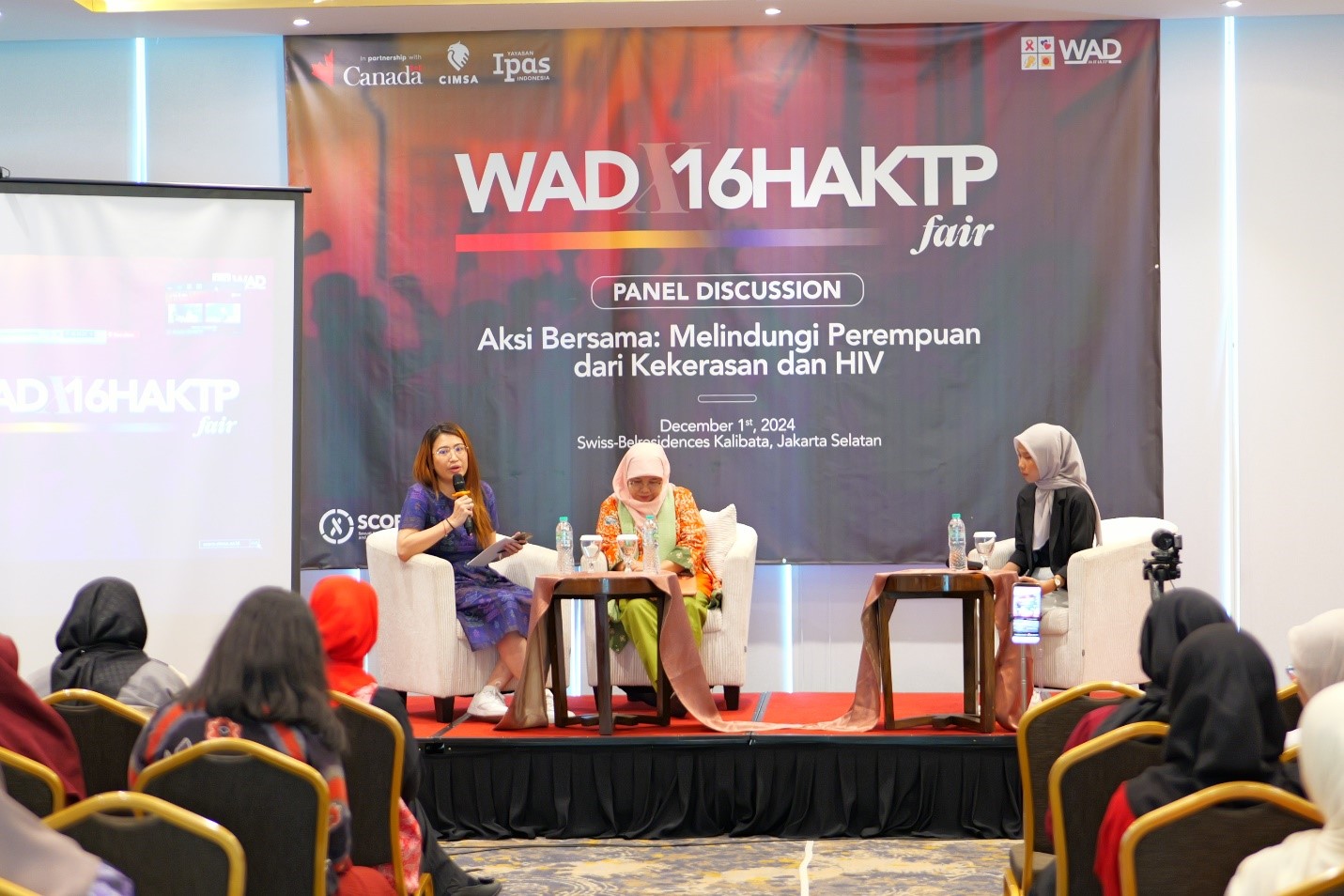
Gender-Based and Sexual Violence (GBSV) and Human Immunodeficiency Virus (HIV) infection are closely linked. Victims of Gender-Based Violence, especially those who experience sexual violence, have a high risk of HIV exposure. Conversely, people living with HIV/AIDS often face violence, whether physical, psychological, or sexual, even from their closest relatives. This makes the burden faced by women victims of GBSV with positive HIV status much heavier due to social stigma and very limited access to healthcare services.
To raise awareness of these two issues, the IPAS Indonesia Foundation, in collaboration with the Standing Committee on Sexual & Reproductive Health and Rights Including HIV & AIDS, Center for Indonesian Medical Students’ Activities (SCORA CIMSA), organized a talk show titled “Joint Action to Protect Women from Violence and HIV” on Sunday, December 1, 2024, in Kalibata, South Jakarta.
Jaclyn Kaunang, Community Access and Mobilization Specialist at the IPAS Indonesia Foundation, stated that many women are still unaware that they have become victims of GBSV.
“From the results of our assessment in three districts in Central Java, we found that one of the factors preventing women from reporting violence is that they are not aware they are experiencing violence,” she revealed.

This indicates the urgency of education and awareness-raising regarding GBSV itself. Furthermore, community support, especially from victims’ families, is believed to be a determining factor in victims’ willingness to report cases and access services.
Hartini, Coordinator of the PPIA Division of the Indonesian Positive Women’s Association, stated that HIV transmission in women mostly originates from their partners; in other words, these women become victims of violence.
“Many women are unable or unwilling to disclose their HIV status due to fear of stigma, discrimination, and the risk of violence that is likely to be inflicted by partners, family, or the surrounding community,” she added.
Alimatul Qibtiyah, Commissioner of the National Commission on Violence Against Women (Komnas Perempuan), emphasized that this stigma affects people with HIV infection in seeking treatment. Moreover, some of this stigma also originates from healthcare providers.
SCORA CIMSA conducted an assessment to evaluate the knowledge, attitudes, and practices of medical students and the general public regarding HIV/AIDS. The survey was conducted online from October 1-28, 2024, involving a total of 105 respondents.

In terms of knowledge and attitudes, respondents generally possess a good level of understanding and a positive outlook. Nevertheless, efforts are required to enhance knowledge regarding HIV prevention, particularly concerning HIV vaccine research and the management of preventing mother-to-child transmission for pregnant women living with HIV.
“The only way to combat AIDS is through prevention, and the only way to prevent it is through education. Let us collectively fight violence, achieve zero HIV transmission, and amplify strong voices to end HIV/AIDS and stigma through unity and action,” concluded SCORA CIMSA.