
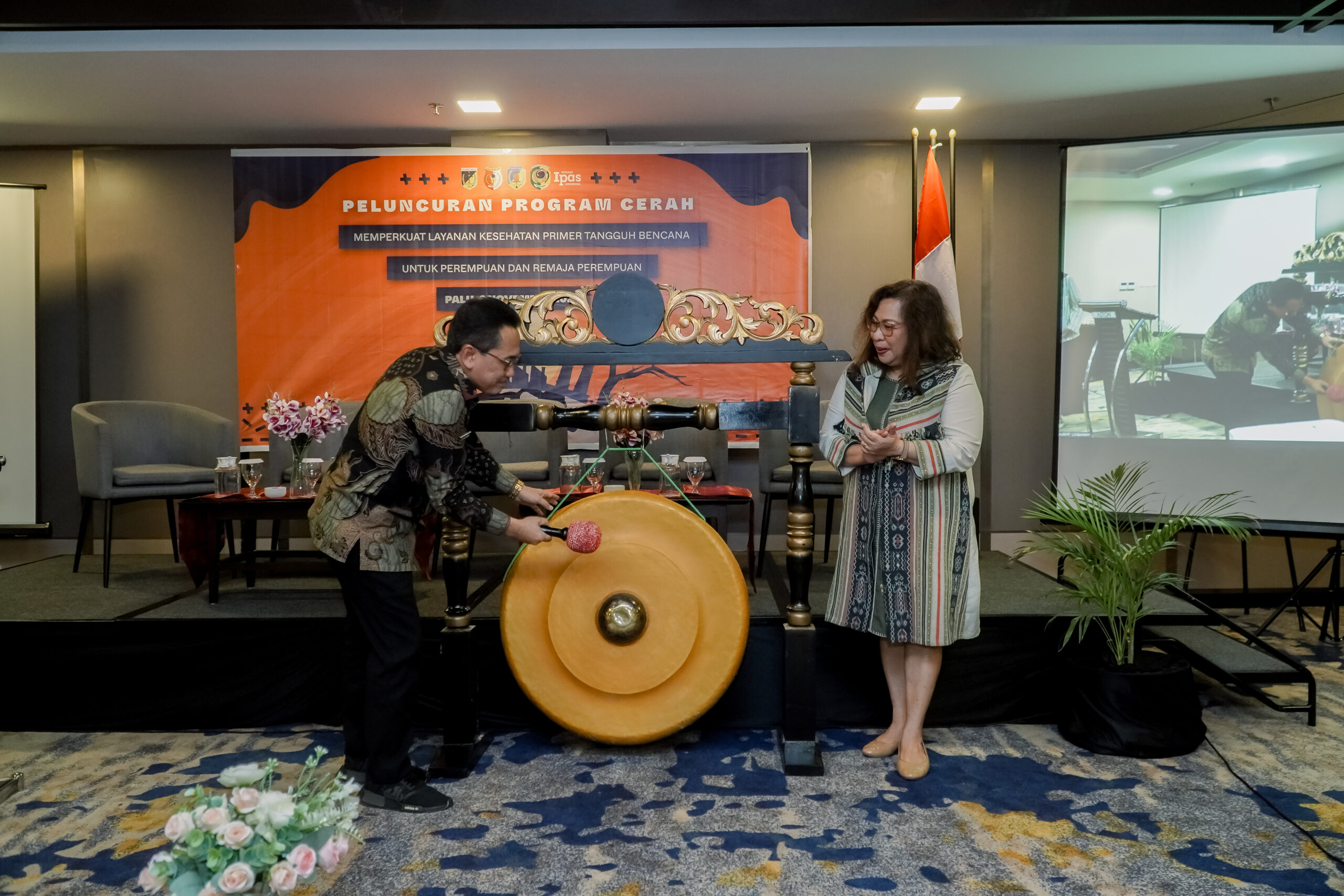
The IPAS Indonesia Foundation launched the CERAH (Climate Emergency, Reproductive Rights and Health) program in Palu, Central Sulawesi, on Tuesday (November 6, 2024). This program aims to enhance the resilience of primary healthcare systems to climate change, within the scope of reproductive health – including the handling of Gender-Based and Sexual Violence (GBSV) cases. The program will be implemented in Sigi, Parigi Moutong, and Donggala Regencies during the 2024-2026 period.
In 2022, the IPAS Indonesia Foundation, in collaboration with Hasanuddin University, conducted research to understand the correlation between the climate crisis and health in Central Sulawesi. The study indicated that the climate crisis, exacerbated by natural disasters, can lead to a health crisis, particularly concerning access to reproductive healthcare services. Furthermore, these conditions contribute to an increase in GBSV cases and child marriage.
Dr. Marcia Soumokil, MPH, Executive Director of the IPAS Indonesia Foundation, stated that the resilience of healthcare systems is urgently needed amidst the ongoing climate crisis. She emphasized that in disaster situations caused by the climate crisis, access to reproductive health, especially for women and adolescent girls, as well as healthcare services for victims and survivors of GBSV, must be a priority.

“We hope that the CERAH program can become a pilot program for regions across Indonesia in enhancing the resilience of primary healthcare systems, both in disaster and non-disaster situations,” said Dr. Marcia.
In his remarks, I Komang Adi Sujendra, Head of the Health Office, representing the Acting Governor of Central Sulawesi, Novalina, stated that adaptation is necessary to prepare a more resilient health system against the impacts of the climate crisis.

“We all know that health is a fundamental human right. However, our communities still face many challenges, especially regarding access to quality healthcare services,” he stated during the program’s opening.
Therefore, he continued, collaboration from all parties is needed to realize resilient healthcare services. “Let us raise public awareness about the importance of reproductive health and the impact of climate change on our health. With good cooperation, I am confident that we can achieve the set goals and provide great benefits for the communities in Central Sulawesi,” he added.
Talkshow on Fulfilling Women’s Reproductive Rights in Facing the Climate Crisis
In this talk show, the IPAS Indonesia Foundation invited Dra. Eko Novi Ariyanti R.D, M.Si, Assistant Deputy for Gender Mainstreaming in Social and Cultural Affairs at the Ministry of Women’s Empowerment and Child Protection. On this occasion, she was represented by Meidiani Lestari Dewi, Manager for Women’s Empowerment and Child Protection at the Assistant Deputy for Gender Mainstreaming in Social and Cultural Affairs. The other two speakers were youth representative Aditya from Central Sulawesi and environmental journalist Minnie Rivai from Mongabay.
Mediani stated that the impacts of the climate crisis are not gender-neutral, as women are more affected than men. She highlighted the water crisis resulting from climate change. “Women have to walk long distances to find water, which disrupts their productivity and economic well-being,” she said.

She added that the Ministry of Women’s Empowerment and Child Protection has also committed to mainstreaming gender equality in climate change actions. Among these efforts is ensuring that gender equality is integrated into the National Medium-Term Development Plan 2025-2045. “The role of the Ministry of Women’s Empowerment and Child Protection continues to encourage central and regional governments to mainstream gender equality, from budget formulation to reporting across all development sectors,” she added.

From the youth perspective, Aditya stated that many women experience both verbal and non-verbal harassment due to this climate crisis. He learned this after participating in a Photovoice training to explore the impacts of the climate crisis on reproductive health through photographic art. “In the photovoice, I highlighted the impact of the climate crisis, where many women experience itching in their breast and vaginal areas due to water,” he added.
Meanwhile, from the media’s perspective, Minnie hoped that the CERAH program could provide information for reporting on climate crisis and health issues. “Media professionals involved with the CERAH program hope for mutual assistance in providing much clearer data and field facts. If the reporting focuses more on solutions, solution journalism offers excellent answers,” she concluded.