
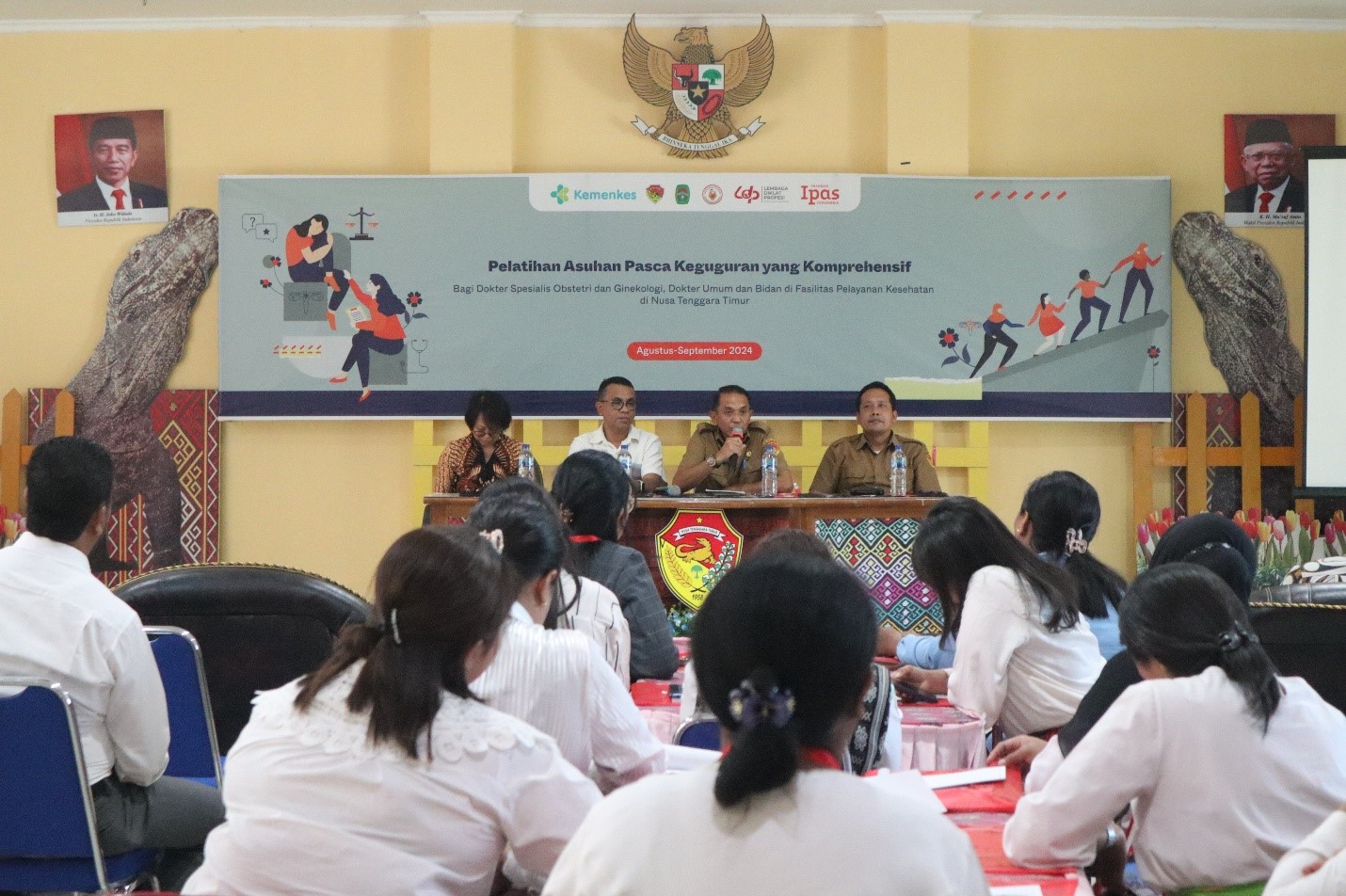
The IPAS Indonesia Foundation supports the Ministry of Health (Kemenkes) of the Republic of Indonesia in conducting comprehensive Post-Abortion Care (PAC) training. This training was held at WZ Johannes Regional General Hospital (RSUD), Kupang, East Nusa Tenggara (NTT), from August 12-16, 2024.
This activity aims to prepare and strengthen the competence of Human Resources (HR), particularly healthcare professionals, in providing comprehensive PAC services as an initial step towards implementing the expansion of comprehensive PAC services in Primary Healthcare Facilities (FKTP), especially Community Health Centers (Puskesmas).
PAC comprises a series of actions to manage women who experience miscarriage. PAC is crucial for reducing the high Maternal Mortality Rate (MMR) in Indonesia. The 2020 census results indicate a maternal mortality ratio of 189 per 100,000 live births. Data from the Ministry of Health’s Health Research and Development Agency in 2012 showed that 4% of maternal deaths were caused by miscarriage.

Particularly in NTT, geographical conditions and uneven distribution of healthcare services remain challenges in managing miscarriage cases. For instance, referral access from community health centers to hospitals is often obstructed by floods during the rainy season. Furthermore, several roads are damaged, and some bridges have collapsed. These obstacles can endanger patient safety.
“To make a referral, first, there’s the cost, and in certain weather conditions, it’s impossible to cross,” said Midwife Saleha Novilla Pattimoa, A.Md.Keb.
Furthermore, the number of medical personnel in regional hospitals, especially obstetrician-gynecologists, is very limited, coupled with a high workload. Meanwhile, so far, patients experiencing miscarriage are usually directly referred to hospitals by community health centers.
“If we have only one hospital in a district, it serves about 13 Community Health Centers. We handle many cases; there are miscarriage cases every day. We have two obstetrician-gynecologists,” said Dr. Yustinus M. Ujan, SpOG(K).

Given these conditions, this training aims to address the challenges by strengthening the capacity of healthcare personnel to expand and bring APK access closer to women. This training was conducted using an accredited Comprehensive APK curriculum.
Inter-professional collaborative approach
In line with national guidelines, this training in NTT emphasizes an inter-professional collaborative approach involving obstetrician-gynecologists, general practitioners, and midwives. The goal is to foster solid cooperation by mutually understanding the roles and authorities of each profession in providing APK services.
This collaborative training concept also aims to ensure the fulfillment of needs for the expansion of APK services to primary-level facilities, in line with the national APK guidelines published in 2020.

With this approach, it is hoped that not all miscarriage cases will be directly referred to hospitals. Instead, services can be provided at community health centers in accordance with APK guidelines. In the national APK guidelines, Primary Healthcare Facilities (FKTP), especially Community Health Centers (Puskesmas) with difficult access to Advanced Referral Healthcare Facilities/Hospitals or in emergency conditions, are authorized to comprehensively manage uncomplicated miscarriage cases with gestational age less than 13 weeks.
Therefore, this training is expected to foster a solid, trusting, and mutually supportive team. Nevertheless, as a supervisor, the obstetrician-gynecologist plays a crucial role in ensuring the implementation of services by the community health center team.
“In my opinion, this training is good, but for obstetrician-gynecologists, the duration is too long. My suggestion is to make it
Use of WHO-recommended medical procedures
Another objective of this training is to introduce Manual Vacuum Aspiration (MVA) tools for performing APK. MVA is a medical procedure used to remove tissue from the uterus using a vacuum device or aspirator. The use of MVA is highly recommended by the World Health Organization (WHO) and the International Federation of Gynecology and Obstetrics (FIGO) due to its safety.

With the introduction of MVA, participants are expected to shift from sharp curettage to the use of MVA. Sharp curettage is a medical procedure to remove retained products of conception by scraping the uterine lining with a sharp, spoon-shaped instrument.
The use of sharp curettage can increase the risk of complications in APK management, such as uterine perforation (uterus punctured by surgical instrument) and Asherman’s Syndrome (scar tissue within the uterine wall). These complications can make it more difficult for women to conceive and can damage the uterine lining. The impact of sharp curettage on women who become pregnant again can lead to placental adhesion during childbirth.
“What I learned from this training is the use of MVA, because MVA has always been taught in courses, but we weren’t very familiar with it, and it turns out sharp curettage has been abandoned,” said Dr. Pujiastuti Wetang.
Data from the Guttmacher Institute (2020) shows that only 67% of hospitals on Java Island have MVA equipment. Of these, only 7% of patients were managed using APK. In NTT, several training participants stated that miscarriage patients are still managed using sharp curettage.
“We still use sharp curettage because MVA is unavailable; we’ve used sharp curettage for 10 years,” said Dr. Edward.
So far, there are two methods recommended by WHO and FIGO for managing miscarriage. The first is operative management using MVA for gestational ages under 14 weeks, and dilation and evacuation for pregnancies ≥ 14 weeks. The second is medical management with the administration of misoprostol according to the dosage in the APK guidelines.
From this training, the IPAS Indonesia Foundation provided MVA equipment to hospitals whose healthcare personnel participated. We also encourage the Ministry of Health to facilitate the procurement of this equipment because MVA is already included in the Ministry of Health’s catalog. This way, APK can be performed at Community Health Centers and hospitals.