
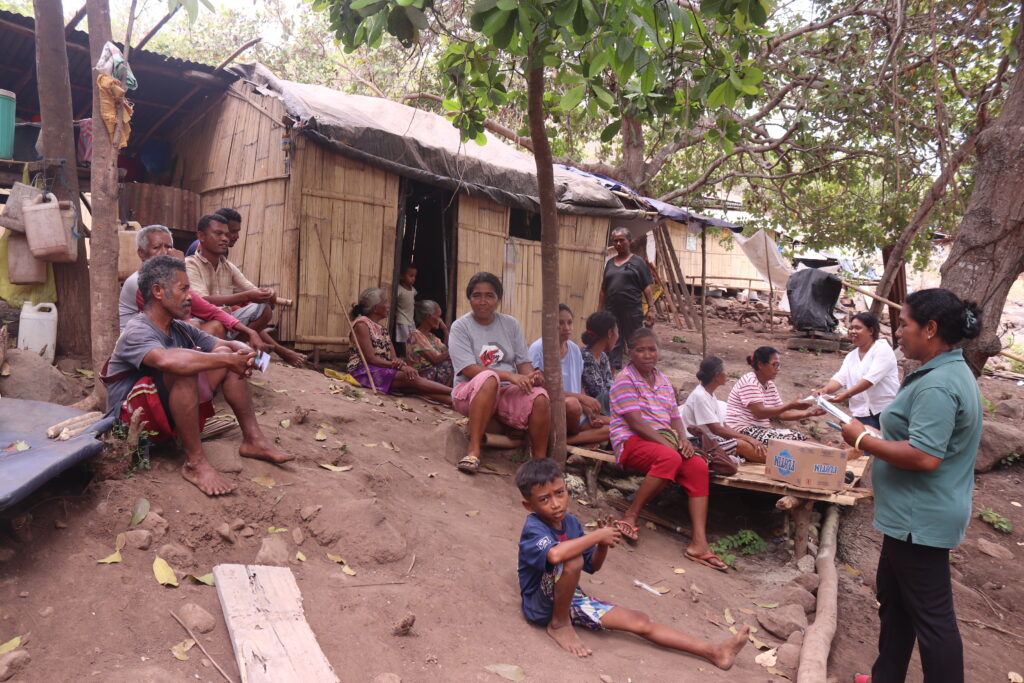
Under the scorching midday sun on September 17, 2025, several residents of Nobo Village were gathered under the shade of trees along the Trans Maumere-Larantuka road, near Waidoko beach. The beach is located one kilometer from Nobo Village’s settlement.
They are self-reliant evacuees from Nobo Village, affected by the eruption of Mount Lewotobi Laki-Laki. Among them stood a woman with a calm yet spirited demeanor. She was Maria Yana Ariyani Bate, affectionately known as Mama Yana.
After the eruption forced them to leave their homes, Mama Yana, along with her husband and five children, built a temporary shelter measuring approximately 4×4 meters in a rocky and arid field. The surrounding ground was hard, filled with large and small stones. The simple hut was only large enough for them to sleep crammed together, while cooking activities were carried out outside, under the makeshift cover of a tarpaulin.
Hot winds from the mountain carried fine dust that clung to their hair and clothes. Outside the hut, a small stove emitted thin smoke from damp firewood. Yet, amidst these limitations, Mama Yana continued to smile. “The important thing is that we are safe,” she said softly. “We can still eat, we can still help others.”
From the Community Health Post to the Educational Platform
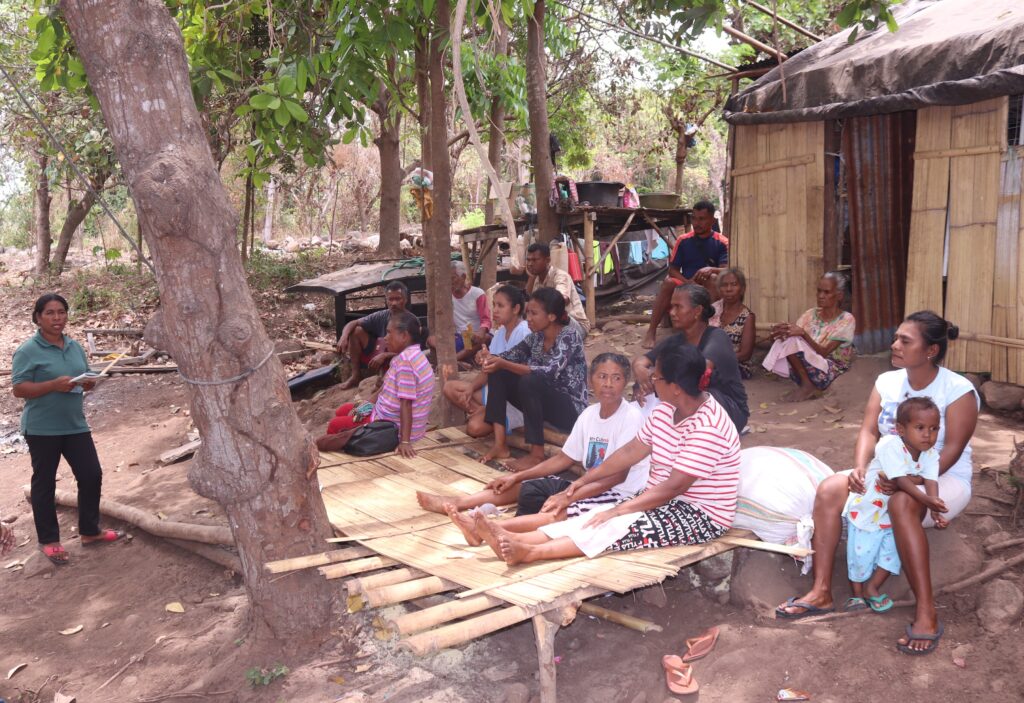
Mama Yana, 37, is a homemaker entrusted as a community health cadre in Nobo Village. Her husband, Philipus Wato Bukan, 41, works as a fisherman. They have five children; four boys and one girl. Besides fishing, the family also owns coconut and candlenut plantations in Dulipali Village. However, after the eruption of Mount Lewotobi, their plantations were damaged, covered in volcanic ash. “Many coconuts were stolen, and the candlenut trees did not bear fruit due to the dust,” she said softly.
Mama Yana became active in the TAKENUSA Program (Joint Commitment for Women’s Health in NTT) since the program was introduced in her village in 2023. Previously, she had already been a Posyandu cadre, but Takenusa broadened her horizons.
“I used to think that if a woman had a miscarriage, she definitely had to undergo a D After attending training from YPPS, I learned that there is a manual vacuum aspiration method performed by an obstetrician-gynecologist,” she said proudly.
Since then, Mama Yana has been accustomed to leading discussions, conducting door-to-door outreach, and campaigning about reproductive health. With a simple yet firm way of speaking, she is able to make residents listen.
Overcoming Social Challenges
Mama Yana’s efforts were not always easy. The biggest challenges, in fact, came from the community’s own perceptions. “Many are afraid of family planning. They say it will cause pain, or they won’t be able to have more children. Even my own mother-in-law strongly opposed me using family planning,” she recalled with a wry smile.
But Mama Yana was undeterred. Together with other cadres, she visited couples of reproductive age from house to house, adjusting her schedule to meet both husband and wife simultaneously. “In the past, when we came, some husbands would immediately leave the house. Now, they even participate in discussions and support their wives,” she said proudly.
Now, almost all couples of reproductive age in Nobo Village are using family planning. A significant change that she attributes to patience and relentless visits.
One of the most memorable experiences was when she had to hitch a ride on a sand truck to the home of a newly married teenage couple who had already given birth. They were also self-reliant evacuees, and their home was quite far to reach on foot. “I asked for time to speak with their family. I explained the importance of family planning because the wife was still too young. Eventually, they agreed to use family planning. That was a moment that made me feel successful,” she said emotionally.
There was also another equally touching story. “There was a family who lost their second child during childbirth. I provided counseling for them to postpone pregnancy for a while. After six years, they stopped using family planning and soon became pregnant again. I was so happy; I felt my efforts were not in vain,” she said with sparkling eyes.
For Mama Yana, being a cadre is not just volunteer work, but a calling from the heart. She admits to often receiving scorn from residents who do not yet understand.
“But I keep it to myself. If they refuse today, I will come again tomorrow or the day after. My intention is only one: to help them,” she stated firmly.
Now, she always visits every pregnant woman in Nobo Village. “Every time I meet them, I tell them, ‘After giving birth, please use family planning,’” she said with a small laugh. The data she remembers shows tangible results: in the last six years, over 160 mothers have used implants, 23 have used IUDs, and an increasing number are choosing postpartum family planning.
Mama Yana dreams that one day in Nobo Village there will be no more teenage pregnancies, and all mothers will adopt postpartum family planning. She also always advises adolescents to maintain good social conduct and focus on their aspirations. To parents, she emphasizes the importance of closeness with their children.
“Children are a sacred trust. Family planning is not about limiting the number of children, but about spacing births to ensure mothers are physically and mentally healthy,” she said, concluding the conversation.
From a temporary shelter in the middle of a rocky field, Mama Yana proves that the power of change does not always come from grand buildings or official stages, but from the heart of a mother who tirelessly sows kindness.