
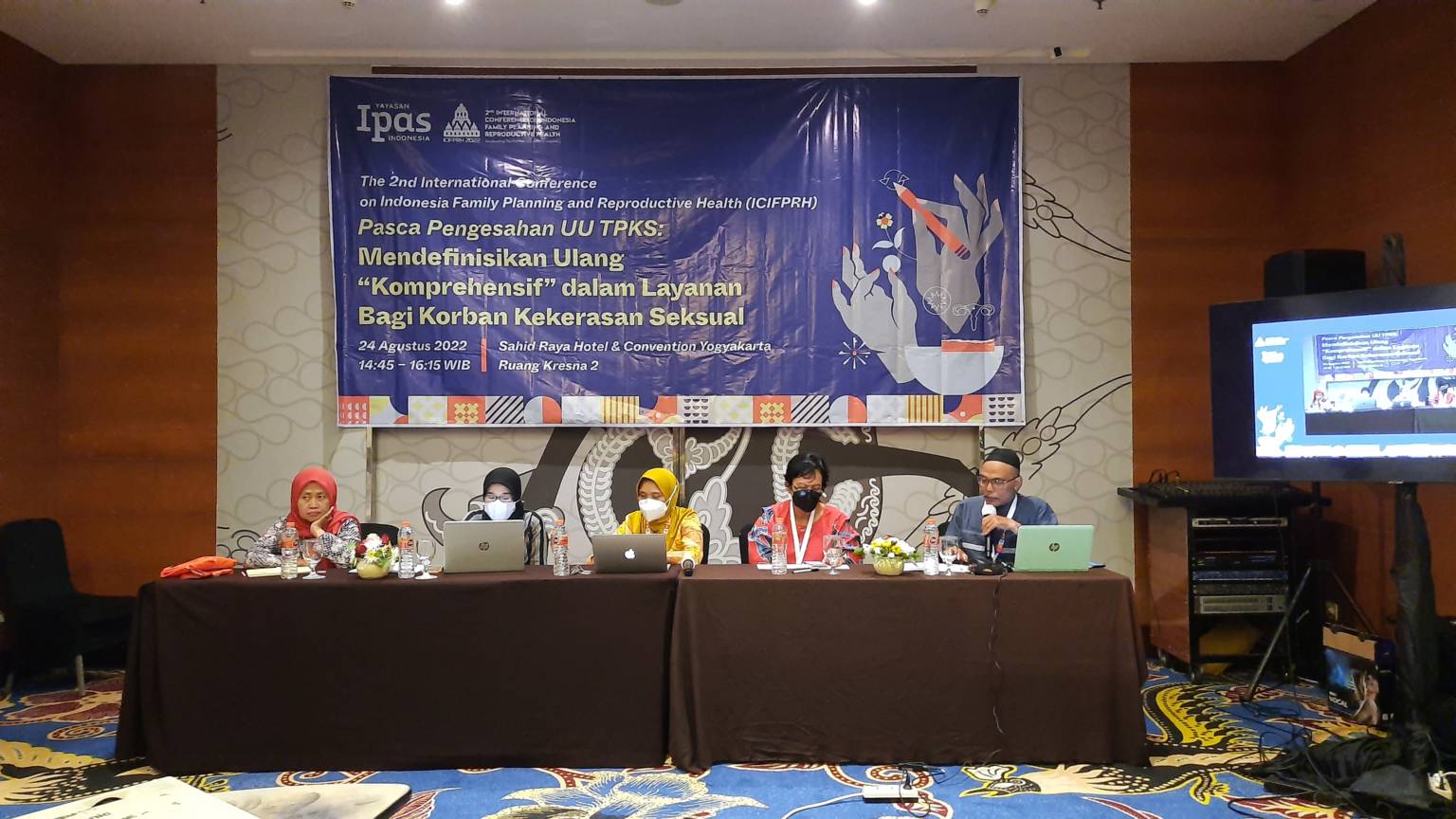
The IPAS Indonesia Foundation held a discussion titled “Redefining ‘Comprehensive’ in Services for Survivors of Sexual Violence” (August 24). This discussion was part of the second International Conference on Indonesia Family Planning and Reproductive Health (ICIFPRH), held at the Sahid Raya Hotel and Conference Yogyakarta.
The focus of this discussion was to explore the challenges and opportunities in providing comprehensive services for survivors of sexual violence under Law Number 12 of 2022 on Sexual Violence Crimes (UU TPKS). The IPAS Indonesia Foundation presented speakers including Sri Nurherwati, SH, former Commissioner of the National Commission on Violence Against Women (Komnas Perempuan) and Chairperson of the Sukma Foundation; Senior Commissioner Dr. Sumy Hastry Purwanti, DFM, Sp.F, Head of the Medical and Health Division, Central Java Regional Police; Suharti, from the Service Provider Forum; and Masruchah, Secretary of the Assembly of the Indonesian Women’s Ulema Congress (KUPI).
Women and adolescent girls who are survivors of sexual violence are entitled to comprehensive services, protection, and recovery in accordance with regulations and laws in Indonesia. This is stipulated in Article 75 of Health Law Number 36 of 2009. So, what about the right to comprehensive services under the TPKS Law?
Sri Nurherwati stated that although the provision of comprehensive services for rape survivors is not explicitly regulated in the TPKS Law, there is still an opportunity to realize these services through the victims’ right to recovery. This is found in Article 67 paragraph 2 of the TPKS Law, which states that the fulfillment of victims’ rights is the state’s obligation and shall be carried out according to the victims’ conditions and needs. Therefore, a Standard Operating Procedure (SOP) in the form of a Government Regulation and a Presidential Regulation is immediately needed for its implementation.
“We need an SOP for the implementation of the law in accordance with the nine types of violence stipulated in the TPKS Law. In this SOP, the evidence must be clear so that it can be used by investigators,” she said.
Drawing lessons from Bhayangkara Level 2 Hospital Semarang, Senior Commissioner Dr. Sumy Hastry Purwanti, DFM, Sp.F, revealed that to provide comprehensive services, cooperation among healthcare professionals, police, and community volunteers is necessary. She also explained the victim-friendly service flow implemented in Semarang.
“Clinical forensics at Bhayangkara Level II Hospital Semarang includes psychologists and companions. Additionally, if you come to the District Police/Sub-district Police, make sure to report to the investigator. If the victim cannot come, the investigator will come. If there is a medical procedure, we will perform it first. If there is a need for forensic clinical services, we will prioritize that,” she explained.
Meanwhile, Suharty, from the Ethics Committee of the Service Provider Forum, explained that there are three main aspects in providing comprehensive services for rape survivors: legal services, psychosocial services, and medical services. “These three basic needs must be met during sexual violence recovery to be comprehensive,” she emphasized.
However, in reality, comprehensive services are currently not widely available. Some regions that have implemented service quality standards from the Department of Women and Child Protection (PPA) are Batang, Yogyakarta, and Semarang.
“These regions have clearly stated the availability of safe abortion services for rape survivors in accordance with the Health Law, whereas in other regions, there is not even information about these services, including how to utilize the golden 72-hour period to save victims from the risk of pregnancy due to rape,” she said.
Suharty added that this is exacerbated by counselors’ lack of sensitivity in utilizing the regulation (safe abortion for rape survivors) which only allows a gestational age of 40 days. Furthermore, doctors find it difficult to provide services, citing their medical oath.
Various efforts made by the service provision forum include initiating an integrated criminal justice system in collaboration with Komnas Perempuan. However, some regions are hesitant to create Regional Regulations due to the need for a legal basis. Therefore, the TPKS Law is expected to provide this legal basis through its articles on the fulfillment of victims’ rights for recovery and protection, covering victims, their families, and companions.
Efforts to provide comprehensive services for rape survivors are also a focus of KUPI’s work. Masruchah, Secretary of the KUPI Assembly, explained that the religious perspective uses a community welfare approach with a mission for the good and justice of rape survivors, based on law and religion. “Religion prohibits acts that threaten life; sexual violence has implications for mental and emotional distress, preventing women from participating in public life,” she said.
One important work undertaken by KUPI is the issuance of a fatwa supporting victims’ rights to comprehensive services in accordance with the Health Law, by extending the service period from the initial 40 days to 120 days. This fatwa will be one of the aspects presented at the upcoming congress in November, involving 28 provinces in Indonesia and 20 countries worldwide.
The availability of comprehensive services for rape survivors is an important part of the overarching theme of ICFPRH 2022, which is accelerating the “three zeros”: ending maternal deaths, ending unmet family planning needs, and ending gender-based violence and harmful practices against women and girls. Through this TPKS Law, it is hoped that legal force can be provided so that comprehensive services can be accessed by survivors of sexual violence and rape.