
Public discourse on sexual violence can be constructed, perpetuated, and challenged through narratives in mass media. So, how have these narratives been viewed so far by media practitioners and civil society groups?
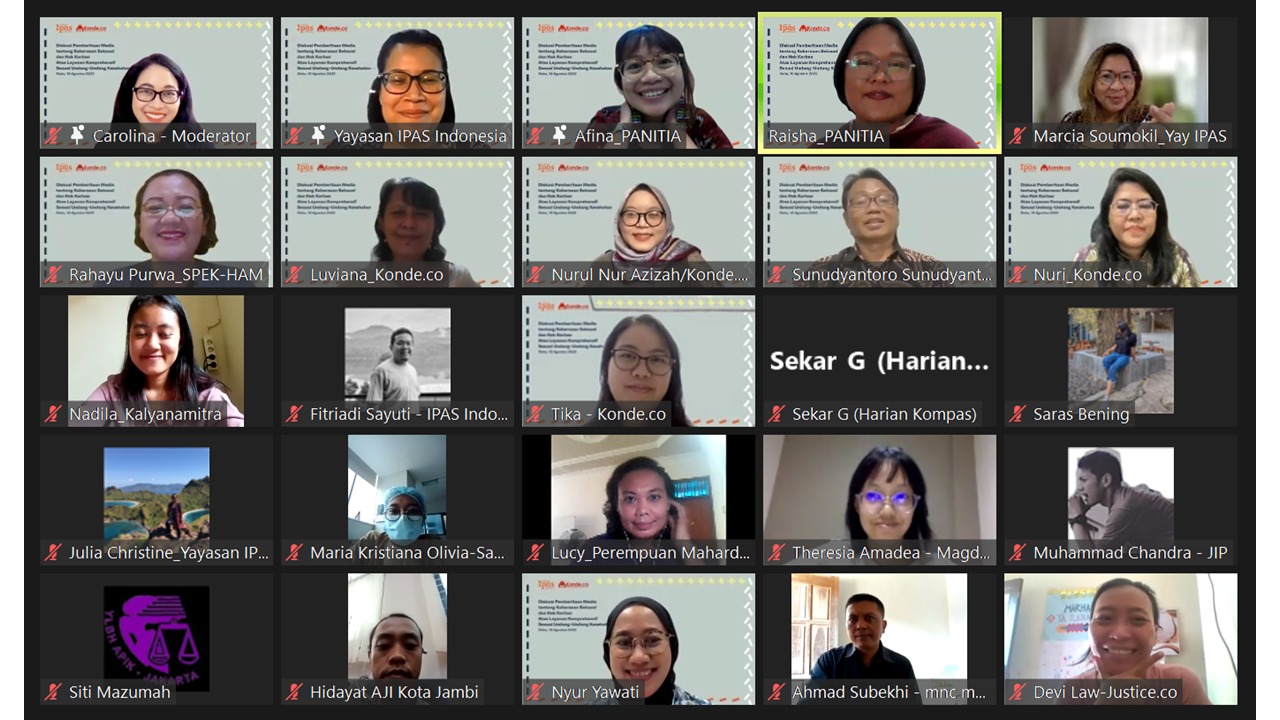
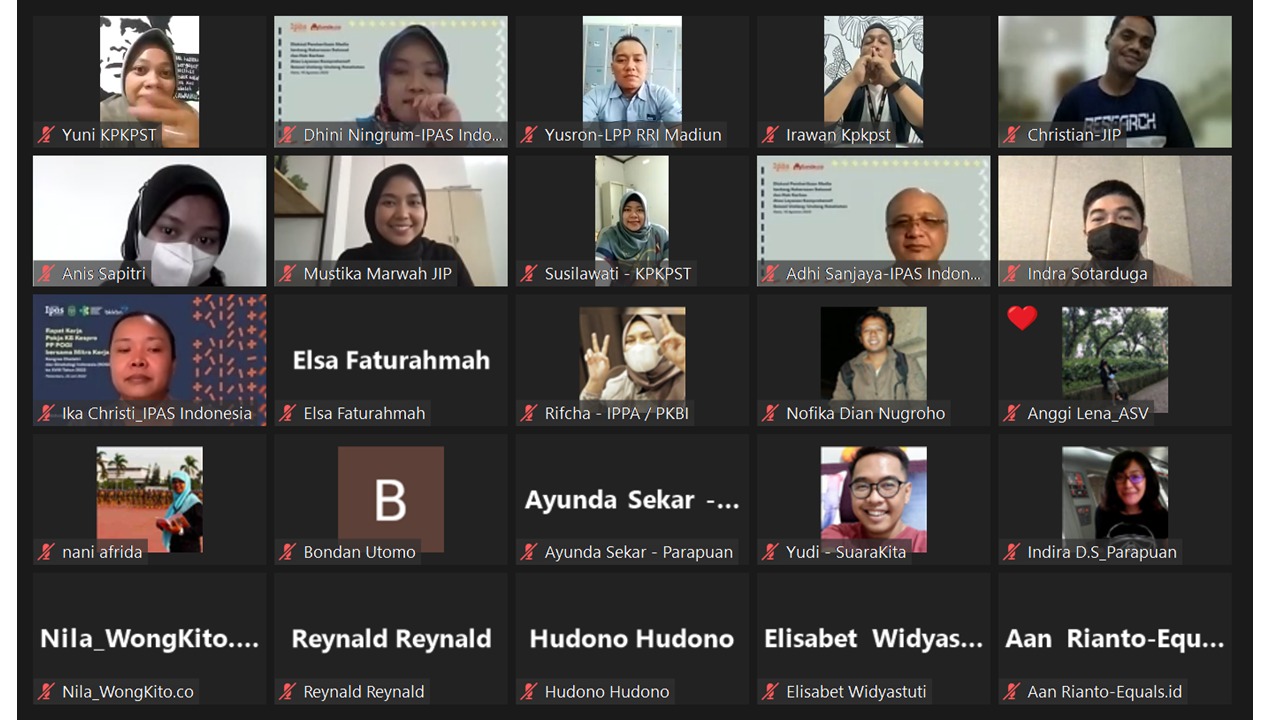
The IPAS Indonesia Foundation held a public discussion on media coverage of sexual violence and victims’ rights to comprehensive services in accordance with the Law on August 10, 2022, online. The event was attended by approximately 60 participants from civil society networks working on Sexual and Reproductive Health Rights (SRHR) issues, as well as national, local, and community media networks.
The three main agendas of this discussion were to reintroduce the issue of comprehensive services for rape victims, obtain additional data and information for study enrichment, and agree on potential collaboration with the media on issues of Violence Against Women and Children (VAWC) and Gender-Based Violence (GBV).
The event began with a presentation of research findings by the Konde.co research team on media coverage of comprehensive service rights for rape victims in accordance with the law. This research, conducted in collaboration between the IPAS Foundation and Konde.co, yielded several important notes, including:
- Media widely reports on sexual violence issues only when they are widely discussed; if not widely discussed by the public, the media does not cover them. The media rarely presents expert sources who can provide an objective perspective.
- The lack of understanding among media personnel regarding this issue from legal and medical aspects creates significant stigma and fear if it touches upon social and religious norms.
- Media personnel are limited in conducting in-depth coverage due to the high number of daily news targets.
The research findings received positive responses from the attending speakers, namely Siti Mazumah, Director of the Apik Legal Aid Institute (LBH Apik) Jakarta; Rahayu Purwaningsih, Director of SpekHAM; and Sunu Dyantoro, Managing Editor of Koran Tempo.
Siti Mazumah, for example, welcomed the research findings and this discussion as if receiving new encouragement in assisting victims. According to her, comprehensive services for rape victims are like a lonely path because victims have to bear everything themselves, go through legal processes, and are often blamed. She stated that as an advocate, she did not dare to publicize cases to prevent victims from being further blamed (victimized), especially while the case is ongoing. Consequently, victims find it difficult to access comprehensive service rights to prevent pregnancy resulting from rape in accordance with the law.
“Hopefully, this can be a good start to fulfilling victims’ rights because the regulations actually exist, but there are many obstacles to their implementation, and we feel that,” Zuma said.
As we know, safe abortion services for rape victims are protected by Health Law No. 36 of 2009, Article 75, as well as Law No. 12 of 2012 concerning Sexual Violence Crimes (TPKS). However, in reality, it is still difficult to access these services, and options such as pregnancy termination are not provided to women, leading to long-term consequences. This was conveyed by Ayu from SpekHAM.
“The impacts of the lack of services for victims include survivors of violence risking becoming perpetrators of violence (abandoning babies, killing babies, etc.), the criminalization of victims, and victims losing control over their bodies,” Ayu revealed.
Ayu continued, other negative impacts include when survivors are forced to continue their pregnancy and become single parents, which affects the child’s poor health quality, leading to stunting, inability to provide proper childcare, infant mortality, and disrupted access to education, thus potentially entering the cycle of poverty.
“If survivors are forced to marry the perpetrator, there is also a risk of continuous violence, mental and psychological health disorders, severe trauma, and even depression,” she continued.
The realities on the ground, as conveyed by civil society groups acting as advocates, should be communicated to policymakers that comprehensive services for rape victims are crucial. This is where the media plays a crucial role. This was stated by Dr. Marcia Soumokil, Director of the IPAS Indonesia Foundation.
“The media’s role is very important as part of the pillar of good public service governance, such as how the media plays a significant role in supporting and promoting advocacy for the fulfillment of victims’ rights to receive all services for their recovery, putting pressure on policymakers to implement existing regulations, and providing education to shape public perception,” said Dr. Marcia.
Sunu Dyantoro from Koran Tempo acknowledged the shortcomings in the quality of media coverage regarding sexual violence cases, including the lack of victim-centric reporting.
“Many media reports do not side with victims, exploit victims, disclose victim information to the public, and are full of stereotypes and stigma. These research findings serve as a critique for journalists to work more professionally; this research is essentially the guardian of our journalistic soul, without us having to pay for it,” he stated.
He added that not all journalists have a good perspective on issues of sexual violence against women. New journalists join newsrooms almost every year, most of whom do not yet have an adequate perspective on many issues, including rape and abortion rights. While some media newsrooms have education and training mechanisms for their journalists, others do not.
Therefore, according to him, it is very important to enhance the capacity of journalists on many issues, including rape and the right to safe abortion for victims. Furthermore, it is also necessary to continuously refresh the memory and perspective of editors regarding how to report correctly on issues of rape and abortion rights.
The discussion included a Q session between participants and speakers. Participants were very enthusiastic about exploring the phenomena of implementing rape victims’ rights in Indonesia. Moreover, media awareness to be more comprehensive and victim-friendly in reporting on sexual violence issues is increasing.
The key to untangling the complexities of realizing comprehensive services for rape victims is the collaboration of all parties, both civil society and the media. The IPAS Indonesia Foundation will always support all steps to realize comprehensive services for sexual violence victims in accordance with the law.